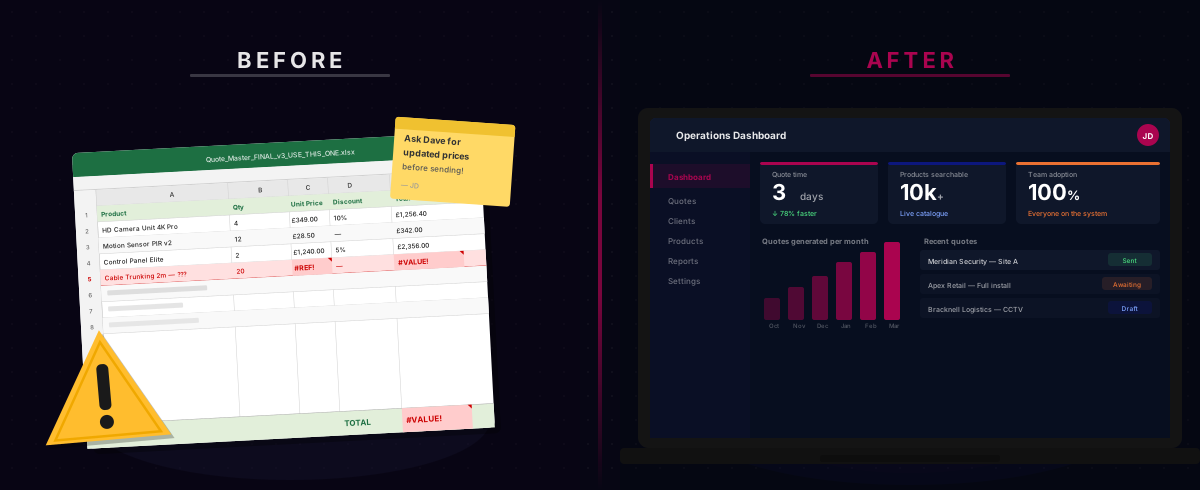
Early in my career I built a system I was genuinely proud of. A website with session management, customer sign-ups, online payments – the works. It worked exactly as it was supposed to. The client tried it, the team tried it, and then quietly, they stopped using it and switched to an off-the-shelf alternative.
That stung. But it taught me the most important lesson I carry into every project: what good is a system if the people it’s built for can’t or won’t use it?
This post is about why software fails to stick in growing businesses, what’s usually really going on when it does, and what the businesses that get it right do differently.

What business owners say when it’s gone wrong
I hear variations of the same thing fairly regularly. “No one uses it.” “They all kept the old system running on the side.” “We put real time and money into this and it never got off the ground.”
What’s painful about those conversations is that the intention was clearly there. The business owner saw a problem, made a decision, invested. And it still didn’t work. Worse, the team end up sounding like the problem – the ones who didn’t get on board, didn’t adapt, didn’t try hard enough.
In my experience, that’s rarely true. The team aren’t the problem. The disconnect is.
Every business is like a fingerprint – completely unique in how it runs, how decisions get made, how work actually flows day to day. Software is like a glove. It either fits or it doesn’t. And when it doesn’t fit, people find workarounds. They go back to what they know. You can’t really blame them for that.
The part most people skip
Here’s what I’ve noticed separates the implementations that stick from the ones that don’t: the team were involved before anyone wrote a line of code or signed up for a trial.
Not just told what was coming. Actually involved. Asked for their opinions. Given options to weigh in on. Invited into testing. Given a genuine chance to shape the thing they’d be using every day.
When you do that, something shifts. The team stop being recipients of a decision made above them and start being part of the product. Their ideas are in there. Their feedback shaped it. All of a sudden they want it to succeed – because it includes a bit of them.
People like to be heard. They like to feel valued. When it comes to the tools they’ll use every day, they deserve to have a say. And the product is almost always richer for it.
But sometimes the problem isn’t adoption at all
There’s a related issue that sits underneath a lot of failed software rollouts, and it’s worth naming separately.
A lot of growing businesses reach a point where the founder has become the process. Not through any deliberate choice – it happens gradually. Decisions get routed through them because they have the context. Exceptions land with them because no one else knows how to handle them. The business builds itself around their presence, and the software – whatever it is – gets introduced into that environment and hits the same wall.
The system can’t capture what the founder knows because it was never written down. The team uses the software for the simple stuff and escalates the rest. Back to the founder, back to the spreadsheet, back to the phone call.
I know this one first-hand. Last summer I was running five or six major projects simultaneously – my own client work, managing a web designer across two briefs, supporting another developer on a client site, and trying to oversee a rebuild of the Alpha Labs website. For the first time I had that many people needing my feedback, approval and direction at once, on top of keeping on top of pipeline.
I remember thinking “he’s going to have to wait, I just don’t have the time.” The developer working on my website wasn’t performing well and I missed it for longer than I should have, because I was overloaded and he wasn’t getting the check-ins he needed.
After that I built guardrails. AI assistants to handle smaller development decisions in my absence. Scripts to automate the repetitive tasks that followed predictable patterns – things that used to take hours now take seconds. I standardised the things that made me a bottleneck, and my bandwidth is genuinely much greater for it. I can still get stretched – anyone can – but the ceiling is higher.
That’s the work. And it applies to your business just as much as mine.

Not sure which of these is your problem?
If you’re reading this and recognising bits of it but can’t quite pin down whether you’ve got an adoption problem, a process problem, or a founder-dependency problem – the honest answer is most businesses have some of all three, and they’re usually connected.
The quiz on this site takes under two minutes and gives you a clearer picture of which type of bottleneck is most likely holding your business back. Worth a look before you make any decisions about new software.
What getting it right actually looks like
The businesses I’ve worked with that have the best outcomes don’t start with the tool. They start with the question: how does this work actually happen?
They map the steps. They agree on what good looks like. They work out which parts depend on a specific person being available – and which parts could be handled consistently by anyone if the right instructions existed. Then the software comes in to serve that process, rather than define it.
That changes the whole conversation. Instead of “does this software do what we need?”, the question becomes “does this software fit the process we’ve agreed on?” That’s a far easier thing to evaluate, and the adoption rate when you’re building from that foundation is completely different.
Where to go from here
If software hasn’t stuck in your business before, the worst move is to buy more of it and hope this time is different.
The more useful starting point is a clear picture of how work actually flows – where it slows down, where it depends on someone specific, and where there’s no agreed standard for how things get done.
That’s what a Systems Audit is designed to uncover. It’s not a sales pitch for software – it’s a diagnosis. We spend time inside your business, map the workflows, and produce a written report with specific recommendations. Some will involve software. Some won’t.
If you go on to work with us, the audit fee comes off the project cost. If you don’t, you’ve still got a clear picture of where to focus.
Find out more about the Systems Audit →
Alpha Labs builds bespoke software for businesses that have outgrown their current tools. Based in High Wycombe, working with founders across the UK.