
For installation companies, commercial plumbers, and construction firms, the quoting process is where profit is either protected or quietly lost. This post looks at why that happens, what a properly structured quoting process looks like, and how the right software can give any member of your team the confidence to quote accurately – not just the person who’s been doing it for years.
The gut feeling at the end of a project
Most trades businesses work incredibly hard. There’s real pride in the work, real effort in the team. At the start of a project there’s usually a good feeling: this one should be profitable.
Then things shift. A few extra products get ordered. Some overtime creeps in. A client adds something to the scope. None of it feels dramatic at the time, but those margins – already loosely defined at the quoting stage – get greyer as the project runs.
By the end, there’s no clean way to look back. You either have a feeling it went well, or you’re looking at the bank balance and it’s not quite where you hoped, and you can’t really say why. So you push forward to the next job.
Years go by and the business hasn’t moved. The issue was never the quality of the work or the effort of the team. It was the absence of the right information at the right time.
That vagueness is expensive, and it compounds.
Where the quoting process breaks down for trades businesses
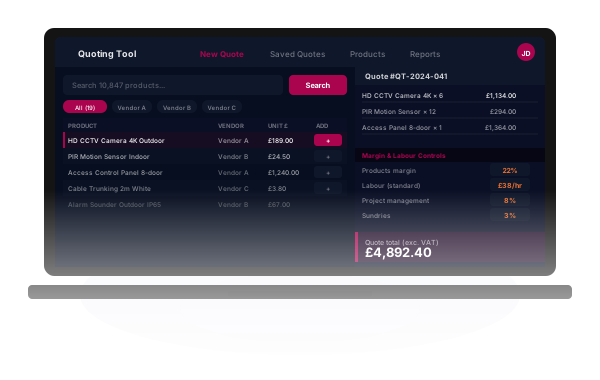
I built a quoting tool for a security installation business that works across nineteen vendors and over 10,000 products. Before the tool existed, the team had to manually search through supplier spreadsheets – all in different formats – to find what they needed, then copy the price across into their quote by hand.
That sounds manageable until you consider the scale. Ten thousand rows, nineteen different formats, and a copy-paste process where a single missed character changes the number entirely. The margin on a job can live or die on a digit.
The searching was one problem. The bigger issue was the lack of structure on the labour and margin side.
The tool has controls for labour types, overtime rates, project management percentages, sundries, shipping, and margin by product category, with the ability to override the margin on specific products when they’re added. It sounds detailed, but it reflects something real: a quote without that level of structure is an estimate wrapped in a hope.
Construction businesses and commercial plumbers face exactly the same challenge. Labour gets estimated loosely. Margin gets added by feel. The quote goes out, the job starts, and when something changes – which it always does – there’s no framework underneath it to absorb those changes cleanly. The profitability that looked reasonable at the start quietly erodes, and nobody catches it until the project is done.
What building this taught me about my own quoting process
Working on this project made me think about my own history.
In the early days of building bespoke software, my quotes were partly based on gut feel. I knew a project of a certain type and size cost roughly X, and I’d work from there. What I didn’t always account for properly was project management time, buffer for overruns, or the cost of the unexpected things that come up mid-build.
Those things still happened. I still had to do them. I just hadn’t charged for them. And there’s a particular feeling that comes with working on a project you know isn’t profitable – where something you were genuinely excited about becomes a burden you just need to get through. It affects motivation. It affects how you show up to the work.
Building this tool and seeing all those layers of control made me look at my own process differently. I’ve since made my own quoting more granular, more grounded in the actual cost of what I’m committing to. The visibility is there when I need it, and that changes how I make decisions mid-project.
“My jobs are all different – I can’t standardise this”
This is the most common thing I hear from trades and installation owners when this conversation comes up, and there’s a version of it that’s fair.
If you’re a sole trader or a very small operation, tight margin control at the quoting stage is probably overkill. Overheads are lower, the team is smaller, and a loose handle on things is often fine at that stage.
For businesses that have grown beyond that – bigger projects, longer runs, more people, more complex client requirements – the complexity is real, and I understand why standardisation feels out of reach. The quoting process has been built up through years of experience and instinct. It lives largely in the head of whoever does it, and it’s genuinely hard to explain to someone else.
That’s exactly the kind of process I work with.
The goal isn’t to replace what an experienced person knows. It’s to capture the spine of that process – the main logic, the rules that drive the decisions, the things that happen in a particular order for a particular reason – and build software around it. That way, the bulk of what makes a good quote can be done by anyone on the team, with the experienced person’s knowledge baked into the system rather than locked inside their head.
Your people keep their skill and judgment. The software handles the manual, the repetitive, and the error-prone. What was complicated becomes modular. What was grey becomes visible.
What a better quoting process changes for construction and trades businesses
When quotes are grounded in real margins from the start, decisions get easier. If a client wants to add something mid-project, you can assess it against the numbers rather than absorbing it and hoping for the best. The figures are live and traceable, not locked in a spreadsheet that stopped reflecting reality three weeks ago.
The team gets more capable too. When the quoting logic is in a system rather than in one person’s head, more people can produce accurate quotes with confidence. The business stops depending on a single person being available.
And profitability becomes something you manage actively, rather than something you discover – or don’t – when the job is finished.
Where to start if your quoting process needs work
If any of this sounds familiar – the loose margins, the gut-feel estimates, the end-of-project uncertainty – the right starting point is a clear picture of how your current quoting process actually works, where the gaps are, and what a better version would need to do for your specific operation.
That’s what a Systems Audit is for. We spend time inside your business, map the process as it actually runs, and produce a clear set of recommendations. Some will involve software. Some won’t. Either way, you come away with a sharper picture of where the money is going.
Find out more about the Systems Audit →
You can also read about the quoting tool we built for Nexus – a security installation business working across 10,000+ products and nineteen vendors – in the case study below.
Read the security installation case study →
Alpha Labs builds bespoke software for businesses that have outgrown their current tools. Based in High Wycombe, working with founders across the UK.