
You’d think a tuition centre, a plumbing firm, an occupational therapy practice, a marketing agency, a social care provider and a childcare recruitment business would have nothing in common.
Then I went back through the discovery calls.
Seven conversations, six industries, all UK businesses somewhere between two and fifteen people. Different services, different customers, different software. And once you put the transcripts side by side, they’re almost the same call. Five problems came up again and again — in the owners’ own words.
The spreadsheet became unmanageable
“We do basically everything on spreadsheets and we have a lot of duplication,” the office manager of a tuition business told me. “Sometimes our Excels don’t sync up with each other.”
A practice owner in a completely different sector: “We had this colour-coded spreadsheet… it became an absolute nightmare.”
Nobody chooses spreadsheets as their business system. They’re just what was there on day one — and they scale by adding tabs until, one day, they don’t.
Email is the system
“Everything’s on email,” a care provider said. Their staff would email themselves to store case information in Outlook folders. Weekend updates lived in a message “always just pinned at the top.”
A plumbing firm owner put a number on it: “Booking, for me, is the hardest thing of the work. We go through a series of emails to arrange any simple booking.”
If your process lives in an inbox, your process is whatever the inbox looks like today.
It’s all in someone’s head
“A lot of this information is in my head as the owner, and I need to get that into something more systemised,” one owner admitted.
Another was facing his bookkeeper of many years retiring: “It’s very hard for me to train someone to do what she does.”
This is the quiet one. It doesn’t hurt day to day — until the person leaves, gets ill, or goes on holiday. One founder put it perfectly: “I’ve become an administrator, not a business owner.”
Off-the-shelf never quite fits
Every one of these businesses had looked at ready-made software. The verdicts:
“They’re usually quite sales-based, and it feels quite difficult to translate that into what we’re actually looking for.”
“It’s so good, but so complicated for me… you’ve got a very powerful thing on your hand, but I don’t know how to use it.” — from someone twelve years into paying for that tool.
“Maybe I’m not going to find anything that does everything I need… I should be happy with 70%.”
And on per-user pricing: “If we’re paying fifty pound per user per month, that’s a huge amount of money. We might as well just build our own, right?”
Settling for 70% isn’t a software decision. It’s a tax you pay every day, in workarounds.
The DIY automation graveyard
The most painful quotes came from the owners who’d tried to fix it themselves with low-code tools and AI assistants.
“Honestly, I must have spent 20 hours doing this… and it was literally a load of rubbish. I got to the end of it and it still doesn’t work.”
“It just sends you down a rabbit hole, because it so wants to do what you’re asking it to do.”
And the line that stuck with me most: “When I say it out loud, it sounds really simple. But I don’t get there.”
The part nobody could do
Here’s the thing. The pain wasn’t the surprising part — every one of these owners knew their spreadsheets were creaking. They’d known for years.
The surprising part was this: not one of them could describe what would replace it. They could describe the problem in forensic detail — the three spreadsheets, the pinned email, the retiring bookkeeper.
But, you can’t solve or evaluate what’s next if you can’t picture it.
And, that’s the gap, which is why we built a preview tool instead of a pitch.
See it instead of imagining it
Answer eight quick questions about how your business runs — where the duplication is, what lives in whose head — and you’ll see a preview of what a system built around your answers would look like. Not a template. Not a demo of someone else’s software. Yours.
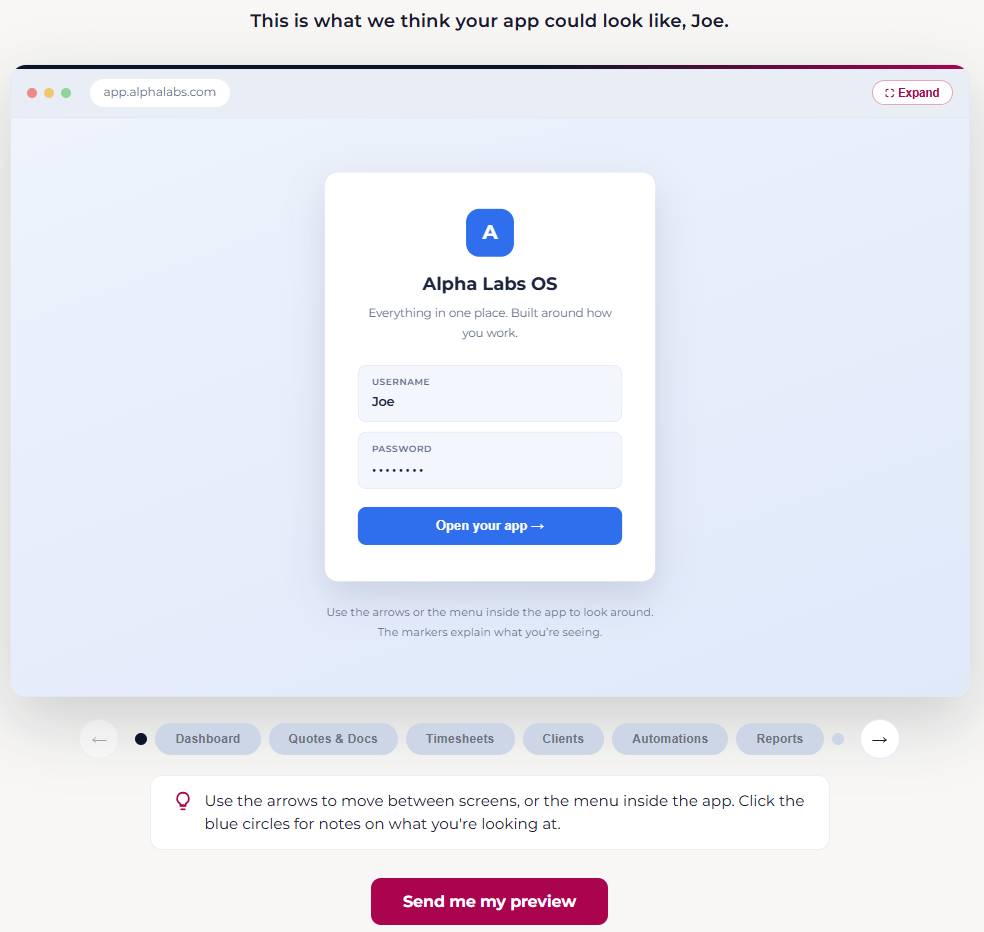
It takes about a minute. No sign-up, no email address, no sales call. And it comes with an honest read on whether custom software is even worth it for you yet — because sometimes the right answer is “not yet”, and you deserve to know that before anyone sends you a proposal.